Showing posts with label nature. Show all posts

Friday, November 4, 2011

The Thing on the Beach

A sunny autumn day on an Oregon beach always amazes and delights me.

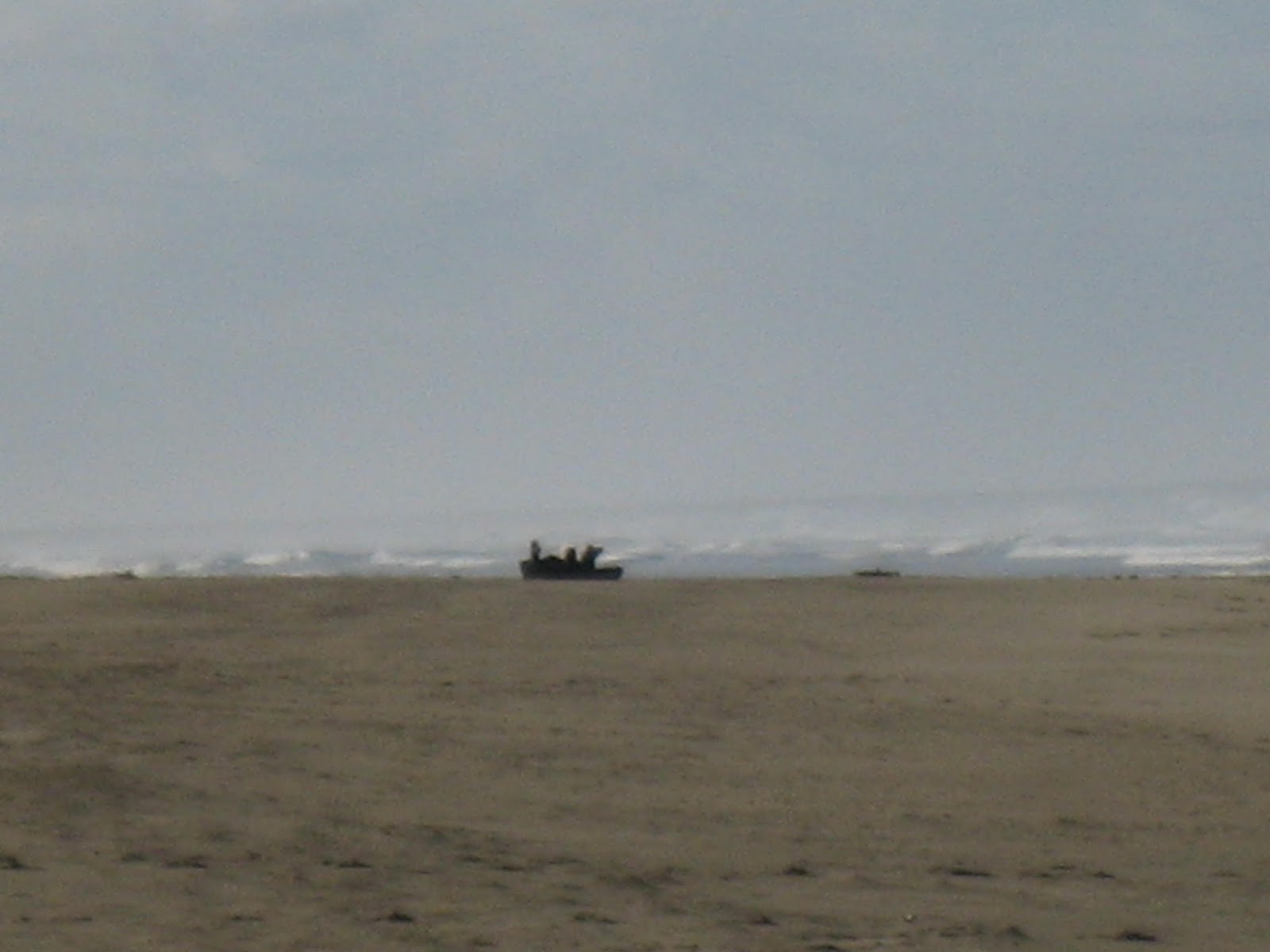
The other day as Hal and I ambled along on the sands, we saw something else that began to amaze us as we approached it. From a distance it appeared to be some kind of  huge driftwood configuration, but it only grew stranger in appearance as we drew near. We named it The Thing on the Beach. 
 We decided it must be a log with three people sitting on it, having a chat.  Yes.  “I’m sure they’re moving,” Hal said. The knobs on the log did seem to be slightly swaying in the breeze.  But the closer we came, the less they moved.
Finally we closed in.  No people, but rather an upside-down complex root system that further stimulated our imaginations. The Thing on the Beach became the Congress of Beasts.
The snooty llama was obviously trying to assert her leadership.
The giant bull frog grumpily complied.
The long-necked fox let his point of view be known.
The earless camel joined the debate….
…as did the sleepy walrus….
…and the pig.
No consensus was reached on any of the items discussed, but at least they were all facing the same direction. I suppose that in itself is amazing in any kind of congress.


Thursday, September 1, 2011

I collect, therefore I am

Several centuries ago, RenĂ© Descarte wrote, “I think, therefore I am” (1637), thus laying one of the foundational stones of Western philosophy. Modern thinkers challenge Descartes’ affirmation, in search of a more holistic image of human existence. But approaches to the essence of humanness abound. The Latin American equivalent might be, “I relate, therefore I am.” Some would say that the North American version is, “I consume, therefore I am,” or, for the workaholics among us, “I produce, therefore I am.”

Recently I spent a delightful afternoon with a friend. Gary talked about his writing projects and among them was a reflection on his collections. The idea originally came from an exercise in self-reflection, pondering what the things we collect say about who we are. I found his article fascinating and insightful and decided to do the same exercise myself.

I’ve been a collector all my life. Much of this stuff I no longer own. My stamp collection became too expensive and demanding, so I finally just gave it away. I outgrew the dolls and comic books. But I still collect. And while I don’t really believe my collections define my existence, it’s still an insightful exercise.

I collect heart rocks. Why? Because they’re small, pretty and very inexpensive. And because I love the way they feel in my hands and the way they sound when I tumble them together. And because it’s a bit of a challenge to find them. Whenever I go to the beach I manage to bring home one or two. When a visitor to my home admires my heart rocks (and not everyone even notices them), I invite her to take one home. For keeps, as my grandkids would put it.


I have a wooden bird collection. These come from Bolivia and show both the beauty of Bolivia’s tropical woods and the skills of her craftsmen. My wooden goose accompanies me every day as I work at my computer, reminds me of where I’m from and what I love.

My wooden puzzle collection speaks mainly to my role as a grandmother. The grandkids love these animal puzzles and, although they’re harder than they look to put together, the kids have become quite good at it. These come from Costa Rica, a place I visit frequently as a teacher and have come to love. They represent the colors, creativity, and natural beauty of this place.

Hal and I both collect books and some of our rooms look rather like libraries. We have several categories of books, and my favorite collection, that includes movies as well as books, has to do with stories about cultural values, communication styles, and intercultural relationships. I especially like books and movies produced by the culture they represent. Favorite authors include (among many others) Khaled Hosseini (Afghanistan), Ynag Erche Namu (southern China), Naguib Mahfouz (Egypt), Isabel Allende (Chile), Ernesto Cardenal (Nicaragua), Sandra Cisneros (Hispanic American), Maxine Hong Kingston and Amy Tan (Chinese American), Jung Chang (China) and Jhumpa Lahiri (Indian American). The movies include my favorite, Babette’s Feast (Denmark), The Necessities of Life (Inuit culture), Eat, Drink, Man, Woman (Taiwan), and Departures (Japan). There are many more, but you get the idea. This reflects my life as a poet, writer and participant/observer, having lived most of my adult years outside the US.

I collect words. I collect them as favorite poems, some committed to memory. I collect funny (always insightful) things my kids and grandkids have said. I remember interesting conversations (some overheard) and billboards along the highways. I store in my mind words that sound beautiful, funny or interesting, as separate entities or in phrases. I use them when appropriate. Hal and I read good books out loud to each other, partly because we like the sound of the words. When we were reading Jacob Have I Loved (yes, a book for young people), we came across the word lugubrious, and just stopped to admire it, guessing its meaning from the context (and later looking it up). I then wrote this poem in honor of the word:

A WORD LIKE LUGUBRIOUS

needs a poem of its own.

Consider the slime and the slink of it,

the slightly sinister wink of its eye

as it peeks from behind potted plants at wakes,

lingers at the altars of Protestant revivals,

or sobs with soap opera heroines.

An irreverent Uriah Heapish word,

a marbles-in-the-mouth sound,

it offers no apologies

for its lumpish singularity.

Some suggestions for everyday use:

--"This piano is lugubriously out of tune."

--"He shed a lugubrious tear

as she passed him the marmalade."

--"This morning at exactly 5:37,

a lugubrious lummox was sighted

at the corner of 11th and Lucerne

in downtown LA. We have investigators

on the scene and will interrupt our broadcast

to bring up-to-date coverage

on this fast-breaking story."

--"Not tonight, dear. I'm feeling lugubrious."


What are some of your collections? What do they reveal about you?

Saturday, June 19, 2010

Meditation on Mark 4:35-41

I must have been seven years old
the first time I heard the story
of Jesus calming the storm.

Being young and credulous,
I accepted it simply. The fishermen’s
amazement came to me

later in life. I, too, learned to question,
“Who then is this that even
the wind and the sea obey him?”

I also learned to question why
doesn’t he do it now. I watch
on TV the oil creep up the shore

of south Florida and I wonder
what the word of authority
would command and through

which channel the command
would flow. I guess I’m asking
how to pray to the One who is the same

yesterday today and forever. With what
words and to whom should I ask him to direct
them? To the ooze floating on the surface,

“Peace! Be dissolved!”?
To the breach on the ocean floor,
“Peace! Be closed!”?

Oh, Lord of the wind and the sea,
of the minerals and the gasses, of the fish,
the pelicans and the marshlands, say something

now. I strain to hear your voice
as the stench of our sin and the silence
of your people begin to overwhelm.

Tuesday, November 3, 2009

The mending moon and the sea lion

Broken and broken
again on the sea, the moon
so easily mends.
(old Japanese haiku)

Hal and I have been at Twin Rocks Friends Camp since Friday afternoon. During the weekend, we joined with Fred Gregory in leading the annual Seminar by the Sea on the topic, “US Christians: Understanding and Engaging the World’s New Realities.” We basically told parts of our own cross-cultural stories, encouraged participants to do the same, and, with the help of a challenging bibliography, attempted to come up with helpful principles and attitudes. Lively participation contributed to a good weekend. I’m satisfied, and relieved it’s over.

Now Hal and I are giving ourselves the gift of a week in the Captain’s Cabin, overlooking the ocean.

Yesterday morning I woke up well before dawn and peeked through the blinds to see if the ocean was visible in the dark. What I saw was not dark at all—a full moon, reflected back in the water. I woke Hal up, thinking that even at 5:00 on the first morning of our four-day vacation, he’d be delighted at the idea of a moonlit stroll on the beach. In fact, he was. We quickly layered on warm clothes and made our way outside and down the path.

Dawn was still hours away, but moonlight flooded the wide beach. We were at low tide and the feeling of spaciousness invited us to walk far. As we wandered, the path of light on the water moved with us. One early morning jogger passed us, but other than that we were alone with all the splendor to ourselves.

As we walked the eastern horizon slowly changed from black to grey, and the moon sunk lower in the west. Some time still before dawn we noticed a Black Thing about 30feet away from us on the sand. The unusual shape caught our attention; it didn’t look like sea weed or drift wood. Perhaps it was a wounded animal. Then it swayed and began moving in clumsy jerks toward the ocean. We just stood still and watched, soon recognizing it as a sea lion. It must have swum in with the night’s high tide and then, for some reason, been stranded.

We watched, fascinated, as it lifted its head and ambled forward, stopped, looked around, rolled in the sand awhile, got up and did it all over again. It obviously was drawn to the water, but at the same time it seemed hesitant, as though it were looking back with longing at the land. Following its backward glance, we saw another Black Thing up near the cliffs. A wounded cub or companion? My imagination went to work. Maybe the sea lion itself was wounded?

Over the course of the next 15 minutes we saw it cross about 150 feet of beach and at last enter the ocean. I felt a tremendous relief. And also a curiosity. We decided to investigate the other Black Thing and slowly approached it. If it were a wounded beast, what should we do? Attempting a rescue could result in getting bitten (do sea lions bite?) or in scaring the animal to death before we could drag it to the sea. We discussed this in whispers as we moved closer.

The moon, now covered by mist, didn’t help us, and it wasn’t until we were just two feet away that we realized the wounded beast was a tree stump. So much for the mysterious Black Thing. But in the growing light we studied the markings in the sand, saw where the sea lion had lain, saw where he apparently had thrashed around, and were able to follow his trek back to the ocean. We found no tracks leading inland; these had been erased by the outgoing tides. We also found dog tracks surrounded the area which adds fuel to imagination.

By this time the moon was completely covered by low-lying clouds, and although the sun had not yet crested the mountains in the east, it was clearly dawn, time to go home. Our feet were cold, but our hearts, warm.

What a gift. What a wonderful way to begin a retreat. It leaves me wondering, what next?