We Quakers are in a good position to respond to the Christmas season. With our dual nature of being both Friends of Jesus and those who quake in the presence of the living God, at our best we bring together both the imminence and transcendence of God. Thomas Kelly described the early Quakers as being “ablaze with the message of the greatness and the nearness of God.”
Christmas demands we bring together the nearness and greatness of God. God sent Jesus in an intimate, down-to-earth form—as a helpless baby, needing to be held, changed, fed. That’s the imminence part, God’s nearness to the human condition.
The angels and shepherds got the transcendence part right. I love the King James description of the shepherds being “sore afraid,” uniting pain with terror. More than a helpless baby, this child was the Lord of lords and King of kings in unlikely disguise. Something for the heavenly hosts to shout “Hallelujah!” about.
Sunday in programmed worship, Cherice Bock, our message-bearer, quoted G. K. Chesteron: “Man is bored to death listening over and over to a story he has never heard.” As we listen again to the Christmas story, which we have all heard over and over, I invite you to join me in opening the “eyes of our hearts,” and seeing afresh in the baby, Emmanuel, God with us. Then let us, in the words of the old hymn, become “lost in wonder, love and praise.”
Tuesday, December 6, 2011


Wednesday, November 30, 2011
Stripes on the beach
November was a red-letter month in that I saw the publication of two books. Two! And one of them is a real book.
The real book is called La iglesia latinoamericana: su vida y su mission (The Latin American Church: Her Life and Mission). I coordinated the three person editorial team (with Alberto Roldán and Chuck Van Engen) of this book of essays from 11 Latin American scholars. It’s published by Certeza, a Protestant publishing house in Buenos Aires. It’s been a long and arduous process, but I’m pleased with the result. The book is academic and in Spanish; if these are not barriers, please look it over! (I may blog later on some of the essays, including my own.)
The other book, which is even more “real” (in the velveteen rabbit sense) is published through Bapa Creations Unlimited. You’ve probably not heard of it. It’s my very own (and very unofficial) publishing house. “Bapa” was Alandra’s word for Grandma a few years back. I publish these books around Christmas time, usually in runs of three (one goes to Rwanda, one to Springfield, and one stays home with me).
This latest creation couldn’t be farther from the volume published by Certeza. Rather than academic in level, its destined readership is a three-year-old autistic boy named Peter. The English is pretty straight forward.
One of Peter’s fixations is stripes. He sees them everywhere. A few weeks back when Hal and I were at the coast, I took a walk one day and, like Peter, I saw stripes everywhere. So I took out my camera, and a new book was born. Following are various scenes from Stripes on the Beach.

I went to the beach
and what did I find?
Stripes, stripes, stripes
of every kind.

Wavy stripes in the sand

Ocean stripes
(otherwise known as waves)
swimming to the shore

Sea grass stripes

Shadow stripes

Drift wood stripes

Sky stripes
(otherwise known as clouds)
moving in the wind

Sea shell stripes

Long legged shadow stripes

Bird legs stripes

Wooden bridge stripes

Fuzzy hat stripes

Crooked tree trunk stripes

Stripes in the grass

Stripes in a fence

Venetian blind stripes

And last of all, here am I!
I've pudding on my face
and stripes on my clothes
and it's just about time to close
this book.
Bye bye, stripes! Bye bye, beach!
Monday, November 21, 2011
Prayer of the selfish child
by Shel Silverstein
Now I lay me down to sleep.
I pray the Lord my soul to keep.
And if I die before I wake,
I pray the Lord my toys to break
So none of the other kids can use 'em....
Amen.
(From A Light in the Attic)
Now I lay me down to sleep.
I pray the Lord my soul to keep.
And if I die before I wake,
I pray the Lord my toys to break
So none of the other kids can use 'em....
Amen.
(From A Light in the Attic)
Wednesday, November 9, 2011
Three women, three stories
I recently read four non-fiction books chronicling the stories of three women. The life circumstances of these women couldn’t have been more different, but their reflections point to the universals of human experience. I’m fascinated by the shared aspects of their lives, the ways they differ, and the power of story to reveal truth.
Two of the books are the memoirs of Iranian writer Azar Nafisi, Reading Lolita in Tehran: A Memoir in Books (2003) and Things I’ve Been Silent About: Memories of a Prodigal Daughter (2008). The third book is Hilary Spurling’s biography, Pearl Buck in China: Journey to the Good Earth (2010). And the fourth book is by theologian Roberta C. Bondi, Memories of God: Theological Reflections on a Life (1995).
All three stories reveal the power of place (cultural and historical context) to form lives. Pearl Buck grew up as a missionary kid in China and spent a good deal of her adult life there as well. And while she herself felt more Chinese than American, being a “foreign devil” during the Boxer Rebellion and the violent conflict between Chiang Kaishek’s nationalism and Mao Zedong’s communist revolution marked her life. Azar Nafisi was raised in the Muslim context of the Shah’s Iran and lived through the radical changes, especially for women, brought by the Islamic Revolution under the Ayatollah Khomeini. Roberta Bondi spent much of her childhood in the shadow of the Christian fundamentalism of rural Kentucky and later, as a young scholar, under the contrasting influence of a rational male-oriented seminary education. All these contexts, in different ways, devalued women, setting up similar struggles for all three.
All three women found solace and hope through the power of literature and language. As a girl, Pearl Buck learned Chinese and soaked up the legends and mythology of her people. As an adult her stories of the Chinese people earned her both a Pulitzer Prize and a Nobel award. Azar Nafisi’s book, Reading Lolita in Tehran, chronicles her clandestine reading group and how reflecting on the works of Nabokov, Fitzgerald, Henry James, and Jane Austen (all forbidden Western authors) helped her and her students find their way through the difficult days of the revolution. Roberta Bondi also writes of the books that helped bring balance and hope to her early years, but it was language itself, in particular the Hebrew language, that gave her a sudden epiphany, “a sense of cosmic goodness and joy in all created things I had never encountered before.”
All three women experienced the power of family to harm, as well as to heal, and a good deal of their personal development had to do with coming to terms with the damage. Buck and Bondi faced the trauma of harsh fathers, while Nafisi wrestled all her life in a difficult relationship with her tyrannical, emotionally unbalanced mother. In some senses, all these relationships with parents were abusive and all the women suffered the trauma of abandonment. In addition, all three entered into unfortunate first marriages and resulting divorces.
And all three women eventually find healing through understanding and forgiving their offending parent, all forming new relationships before the death of the parent.
Azar Nafisi does not write about any kind of relationship to God or the Muslim faith. Both Buck and Bondi were raised in Christian homes. Pearl Buck eventually rejected the Christianity of her parents and did not find a replacement. In contrast, Bondi outgrew the rigid fundamentalism that formed the backdrop of her childhood and slowly moved into a rich and deep Christian spirituality with a God of grace.
Pearl Buck died in 1972. Azar Nafisi lives in the United States, teaches college literature and directs the Dialogue Project at the Foreign Policy Institute of Johns Hopkins University. Roberta Bondi is Professor of Church History at Candler School of Theology, Emory University, in Atlanta, Georgia.
Of the three, the story that impacted me the most was Roberta Bondi’s, but that’s a topic for another blog.
Friday, November 4, 2011
The Thing on the Beach
A sunny autumn day on an Oregon beach always amazes and delights me.
The other day as Hal and I ambled along on the sands, we saw something else that began to amaze us as we approached it. From a distance it appeared to be some kind of huge driftwood configuration, but it only grew stranger in appearance as we drew near. We named it The Thing on the Beach.


The other day as Hal and I ambled along on the sands, we saw something else that began to amaze us as we approached it. From a distance it appeared to be some kind of huge driftwood configuration, but it only grew stranger in appearance as we drew near. We named it The Thing on the Beach.
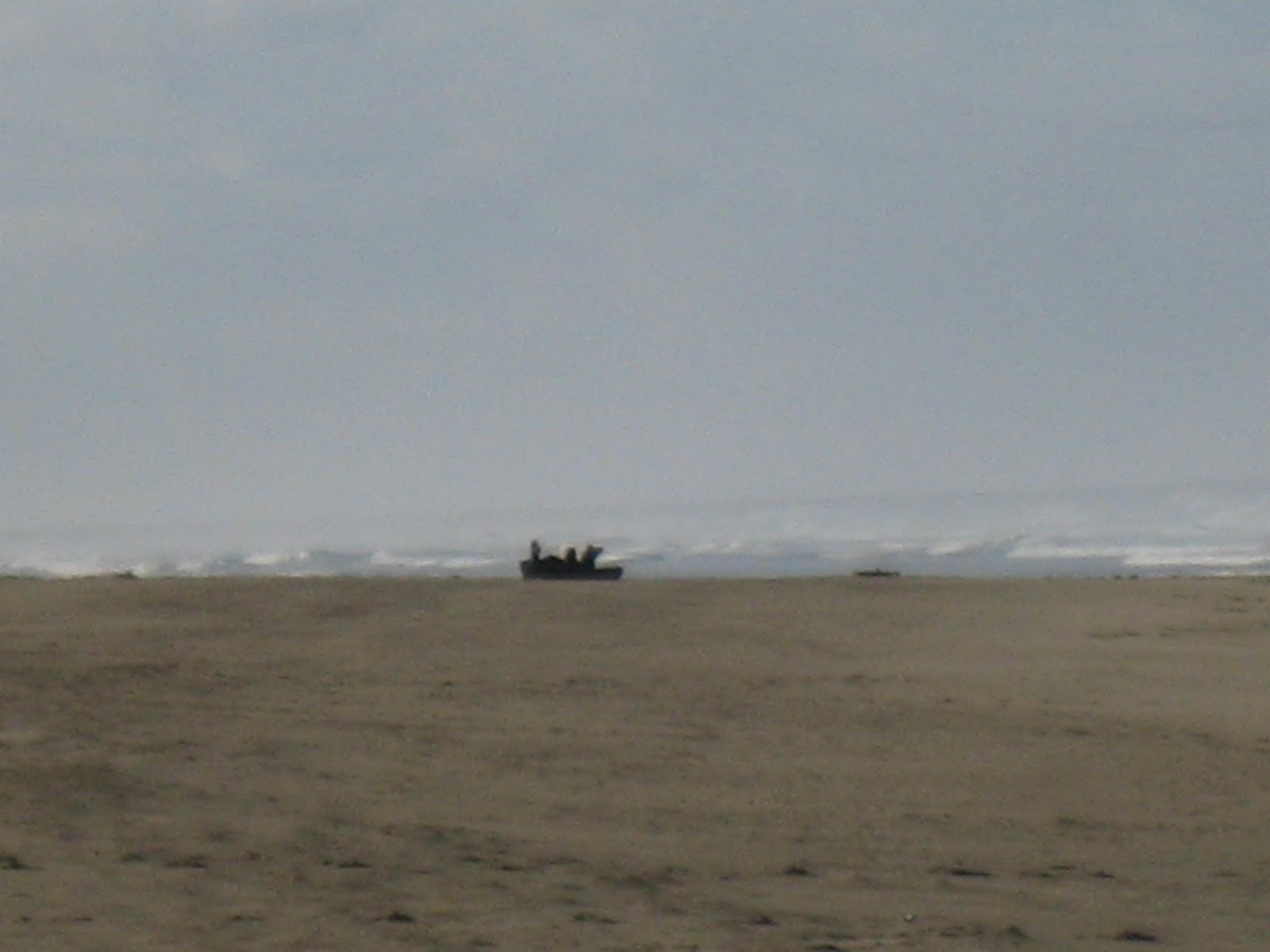
We decided it must be a log with three people sitting on it, having a chat. Yes. “I’m sure they’re moving,” Hal said. The knobs on the log did seem to be slightly swaying in the breeze. But the closer we came, the less they moved.

Finally we closed in. No people, but rather an upside-down complex root system that further stimulated our imaginations. The Thing on the Beach became the Congress of Beasts.


The snooty llama was obviously trying to assert her leadership.

The giant bull frog grumpily complied.

The long-necked fox let his point of view be known.

The earless camel joined the debate….

…as did the sleepy walrus….

…and the pig.

No consensus was reached on any of the items discussed, but at least they were all facing the same direction. I suppose that in itself is amazing in any kind of congress.
Wednesday, October 26, 2011
The good death
I just found out that Al Lehman died on Monday. It’s been a long journey, this death.
Al and Lois have been part of North Valley Friends since before its founding. I remember when Hal and I were newly married and began attending Springbrook Friends, one of the meetings that merged to form North Valley. Al was teacher of the adult Sunday school class. Newly graduated from college, as well as newly married, I was a bit of a rebel at the time, highly critical of anything to do with church. But I loved that class. More to the point, I loved Al and his gentle way of opening the Scriptures and of encouraging us to engage with them and with each other.
In the following years, each time Hal and I would return from Bolivia for our furlough year in Oregon, Al and Lois were a stabilizing factor for us in the church. They were like parents in the faith and never seemed to change, were always part of the life and health of the community we came home to.
I was with the elders visiting Al and Lois in their home on Sunday afternoon. Al never woke up during that time, and his labored breathing formed a sort of background music to our visit. We sat with Lois and Bev, sang some old hymns, with Hal’s harmonica accompaniment—songs like “Blessed Assurance,” “Great Is Thy Faithfulness,” “When the Roll Is Called up Yonder.” We then all talked about what Al had meant to us, and the strong testimony of a consistent, faithful, gentle life unfolded.
Lois shared that the day before God had given her an unexpected gift. Al woke up and was conscious for about an hour. During that time they again expressed their love to each other. Lois was smiling as she told us, “I didn’t think I get another chance to tell him I loved him.” Bev shared about how her father never wanted his last months to be like this, did not want to be so dependent on family for every need, but that as his condition gradually worsened, he just seemed to accept that this was how it was to be. He walked gently and submissively through the whole experience.
We prayed for Al and the family, sat around for a short while longer and left, not realizing this was his last day with us.
I’m remembering reading about the spiritual discipline of the “good death,” a practice in years gone by, not spoken of much anymore. For the life of me (interesting phrase), I can’t find the source of my reading. I’ve googled it and find thousands of references to a “good death,” all contemporary. Today the phrase pertains more to the medical profession than to Christianity, and is linked with practices such as hospice care. It basically means a death with as little physical and spiritual pain as possible. That’s good. Al and the family benefitted from hospice care during the last several months.
But the “good death” as a spiritual discipline has another sense entirely. Rather than something the dying person receives at the hand of others, it is a gift that person gives to others. It refers to letting one’s death be as full of Jesus and of the fruits of the Spirit as one’s life was. It means letting the way the person handles death become a ministry in itself, a blessing to the community. It results in a deep joy that mingles with sorrow as the person finally slips over the edge and into Life.
Of course, for that to even be possible, a person would have to have lived a consistently Spirit-filled life. Over a long period of time. Al Lehman was such a person, and while we will all miss him, I smile as I imagine him now in the presence of the One he loved. And I thank him for giving us the gift of a good death.
Wednesday, October 19, 2011
How it sometimes happens that i am reduced to writing
It starts in the middle of the night
--the witching hour
--the pull of the moon
i slip from sleep
drawn to the lip of chasm
bend in & begin to
spin down & down
i grow small small
as the cone of the vortex
whirls the colors & sounds
& senses of all i’ve ever known
fast fast so fast i forget my name
around & around the dark
shines twirling tumbling me
sucks out my words
my words my very
life until
it slows slows
& stops i
never know how or when
but the vortex vanishes
& i uncurl in the gentled night
hold in my hand
a small pile of words
a singular piece of
poem
Subscribe to:
Posts (Atom)