Showing posts with label Bolivian Friends history. Show all posts

Wednesday, December 25, 2019

Quakers and Indians in California, 1869

In writing of the beginnings of Friends in Bolivia, I tell the story of William Abel, a Native American from California who converted to Christianity in the small Ramona Friends Church in 1897.
I found historian Richard Carrico’s work helpful in providing background to this story. The book, Strangers in a Stolen Land: Indians of San Diego County from Prehistory to the New Deal (2008, Sunbelt Publications), details the history of the Kumeyaay tribal peoples of San Pascual, Abel’s ancestors.
In the first chapter of my book (ALong Walk, A Gradual Ascent: The Story of the Bolivian Friends Church in its Context of Conflict), I present William Abel’s background, conversion story, and contribution to the Friends movement in Bolivia. I refer to US President U.S. Grant’s attempts rectify past injustices to the Indians with his Indian Peace Plan and the instituting of a Board of Indian Commissioners (attempts than were not immediately successful). I quote a fascinating piece of information about Friends in California. Carrico states that Grant’s plans included “placing many of the Indian Agencies in the hands of Quakers, eliminating much of the patronage that had led to the spoils system being rife in Indian affairs, and lessening the power of the military in Indian affairs” (pages 108-109).
Carrico does not footnote this observation. I’m fascinated that the Quaker reputation for a ministry of justice had reached the White House and influenced government policy. I’m now curious to know more about Quaker involvement with indigenous peoples in Southern California.
As usual with historical investigation, among all my discoveries, I found a whole new set of questions.

Maybe someone will write a book about it.


Wednesday, December 11, 2019

New book on Bolivian Quakers!


It’s finally here!

This feels almost like presenting a new baby to the world. Only this one followed six years of hard labor.
Even so, it was a labor of love: love for Bolivian Quakers among whom Hal and I lived and worked for over 30 years; love for the team of Bolivian investigators who accompanied us on this adventure; love for Jesus, the head of the church and the real protagonist of this story.
Love for the country and people of Bolivia also energized this project. Recently, conflicts in Bolivia have been on the news, and many have been praying for peace and reconciliation. The subtitle of the book, “The Story of the Bolivian Friends Church in its Context of Conflict,” illustrates the fact that the recent upheaval, unique in some ways, is actually part of an ongoing drama. Conflict seems to be part of the DNA of this nation’s history, as well as of the Aymara culture among which the Friends Church developed.
A Long Walk, A Gradual Ascent explores how both history and culture affected the development of this evangelical peace church over a period of 100 years.
I found the story fascinating and enlightening. I hope you will, too.

Monday, February 11, 2019

Good News!


Good news! The history book has a publisher. Wipf & Stock has accepted our manuscript, and we’re finally looking at some light at the end of this long tunnel.
A tunnel is probably not the best metaphor for this seven-year project, though much of it has been underground: mining the past in the archives of nine different universities, yearly meetings, mission headquarters, and museums; sifting through a lot of debris; bringing the good stuff up to the top; discovering a few gold nuggets.
And then came figuring out how to organize, analyze, and understand it all, at least enough to begin writing. I have thousands of database items and scanned documents, all backed up and filed away.
But a lot of the research was carried out above ground. The field work required hundreds of interviews with the leaders of the church and, especially, with the children and grandchildren of past leaders. This is where our Bolivian team members were so helpful.
I must confess how joyful most of this work has been. I’m one of those strange people who love to research and write. Although much of this has been drudge work, I’ve been excited to make the discoveries, to begin to see the patterns, to come to understand how God and God’s missionary agents (both expatriate and national) co-labored to plant and develop a community of some 200 Quaker congregations scattered about the Bolivian highlands and tropical valleys.
And now I’m excited to be able to share the story with others.
Our working title has us climbing a mountain—A Long Walk, A Gradual Ascent: The Story of the Bolivian Friends Church in its Context of Conflict. I like the mountain metaphor better than the tunnel. It’s more accurate.
I still have to do my final editing, including cutting down the size of the book. I hope to have the final manuscript to the publisher by early April. Actual publication may take up to year from that date.
Rejoice with us!


Tuesday, January 8, 2019

How many Quakers does it take?


Actually, this is not a joke about changing a light bulb. (If it were, I imagine the answer would have to do with how hard it is to come to consensus on weighty issues.)
Rather, this is a story about how many different yearly meetings contributed to the beginnings of the Bolivian Friends Church (INELA).
In previous blogs we’ve seen how a Native American who was converted and discipled under California Yearly Meeting gave his life as a missionary to Bolivia after a few months preaching on the streets of La Paz. We’ve seen how this man, William Abel, partnered with Quaker missionaries from yearly meetings in Kansas (Florence Smith) and Indiana (Emma Morrow and Mattie Blount) in 1919, a year of beginnings.
Our attention now turns to a young Bolivia mestizo, Juan Ayllón, who was drawn to the witness of these early Quaker missionaries and became a convinced Friend, also in 1919. Ayllón was particularly attracted by William Abel, having encountered him one evening praying publicly in a street meeting. Ayllón found himself moved by the power and sincerity of Abel’s prayer, and he determined to get to know him. Ayllón joined Abel and the others in their street ministry, attended Abel in his bout with small pox, and helped bury him in the public cemetery in La Paz. It had been a brief but highly impactful relationship. At that point Juan Ayllón seemed to take on the mantle of William Abel, including Abel’s convictions about adequate preparation for Christian service.
Through Emma Morrow’s contacts with the fledgling mission work in Central America, Juan Ayllón received an invitation to study in the new “Berea Training School for Christian Workers” in Guatemala. Missionary to Guatemala, R. Esther Smith (California Yearly Meeting) was especially interested in this young Bolivian and offered him a full scholarship in the new training school. So, in the fall of 1920, Juan Ayllón began a four-month journey (via trains, boats, and a donkey) from La Paz, Bolivia to Chiquimula, Guatemala.
The journey itself was a series of misadventures (which you can read about when the book is published). Juan earned his passage through manual labor. Legal problems prevented his disembarking in Central America, and he ended up in New York City, knowing no one and speaking little English.
Arriving on February 14, the ship’s captain let Ayllón occupy his room on board for five days while the ship reloaded. After that time, on a Sunday morning, Ayllón gathered his belongings to leave at a police station in New York City while he attempted to arrange for his passage to Guatemala. A policeman at the station, upon learning that Ayllón was a Quaker, “just happened” to know of a Friends meeting house nearby and gave him directions.
Ayllón was the first to arrive at the meeting house and he prayed in silence for someone to help him. After the meeting, people were interested in his story. Paul Furnas of New York and Frederick Swan of New Jersey hosted him for the next few weeks. Between them they arranged for his trip by train to New Orleans, and then by ship to the east coast of Guatemala. Thanks to the grace and generosity of these Quakers, Juan Ayllón finally arrived in Chiquimula on the evening of March 9, 1921, late for the beginning of classes, but much welcomed.
Ayllón spent the next three years in the Berea Training School. In January of 1924, he married Honduran classmate, Tomasa Valle, and in the Central American Friends Yearly Meeting sessions, Juan and Tomasa were commissioned as their first missionaries to Bolivia. They sailed in April, arriving in La Paz in May of 1924, thus beginning a new phase in the development of the Bolivia Friends Church. In the years between 1924 and 1930, years which saw the first official Friends Churches (INELA) planted in Bolivia, the mission work was supported by the Central American Friends Church and Mission, through the service of Juan and Tomasa Ayllón.
Getting to this place in the story required the contributions of Friends from California, Kansas, Indiana, New York, New Jersey, Honduras, and Guatemala. Oregon Yearly Meeting would not become involved until 1930. But that’s another chapter.
I should also add that Ayllón’s fascinating conversion story involved a Methodist missionary, a Salvation Army evangelistic service, and a small Baptist church, after which Ayllón met William Abel and became a convinced Friend. (Read the book for the details.)
This particular light bulb required many Christians, as well as many Quakers, to finally reach the light-giving point!

Monday, December 17, 2018

1919, a year of convergence in Bolivia


William Abel was not the first known Quaker to visit Bolivia with the intent to share the gospel message. That honor goes to Florence Smith, a recorded Friends minister and Bible teacher from Kansas Yearly Meeting. She had met Abel in the Training School for Christian Workers, probably in 1913, his first year back from the Philippines. The school had invited her to be a teacher, and she served for the 1913-1914 school year. Abel would have been one of her students.
Smith’s passion was evangelism, so she left the school after only one year to pursue a ministry of preaching. We lose track of her activities but discover that sometime around 1917, she traveled to Bolivia as an independent missionary, and found employment in La Paz teaching English.
William Abel graduated from the school in 1916, and after several years working to pay back his school debts, he renewed his relationship to Peniel Missions, the agency that had sent him to the Philippines. Peniel assigned him to Bolivia, apparently to work in a newly established mission farm on Lake Titicaca.
Travelling by boat and train, Abel arrived in La Paz sometime in March 1919. While waiting for the right time to move out to the farm, he occupied himself with selling Bibles (a typical missionary activity of the times) and preaching on the streets of the city. We don’t know when or how he reestablished contact with Florence Smith.
But Smith was definitely active in persuading two other Quaker missionaries to come to La Paz in 1919. The Union Bible Seminary in Westfield, Indiana had been actively looking for a mission field, and partly through Smith’s persuasion, they commissioned two young Quaker women for that work. That very year Emma Morrow and Mattie Blount traveled together and were met at the La Paz train station by Smith. The month was May. The three women began exploring what form their mission work would take. Although their Spanish language skills were largely lacking, the women soon joined forces with William Abel and began preaching on the streets of La Paz.
El Prado, La Paz, the 1930s

On August 21, 1919, Morrow wrote home a description of a three-week series of street meetings where the four ministered together, after having obtained an official permit from the local government. Morrow wrote that,
“We have been out in the ‘Prado,’ one of the main streets of the city every night except two since Aug. 8th, and during that time hundreds of people have heard the Gospel. I believe there has been an average of a hundred people each night that would stand for a full hour, and sometimes longer, to listen, while many came and went, and the attention has been remarkably good….
“We have given away thousands of tracts and have sold 100 New Testaments during the three weeks…. Mr. Able [sic] and Florence Smith do the preaching, and Mattie and I pray and help sing.”
Abel apparently made several converts and influenced several other young Christians, among them Juan Ayllón, a young mestizo Christian. He joined with Abel in the street ministry and was deeply influenced by Abel’s spirit and zeal for the work.
Upon his arrival in La Paz, Abel had written home, “I have a strange feeling that somewhere around these parts I shall end my days.” And, indeed, William Abel died of small pox only eight months after his arrival, on October 12, 1919. Ayllón and Morrow cared for him in his final illness, and Ayllón arranged for the funeral and burial in La Paz. The verse on the marble slab marking his niche reads, “Whether living or dying, I am the Lord’s.”
Ayllón would take up Abel’s mantel in the years to come. Today the Bolivian Friends Church (INELA) considers both Abel and Ayllón to be its founders, Abel’s sacrificial death being the seed of the church (John 12:24).
But the year 1919 and the convergence of Friends missionaries from different yearly meetings (Kansas, California, and Indiana) would prove to be the foundation of all the Quaker work that would later grow up in Bolivia. These would eventually find expression in the different Bolivian yearly meetings, the largest being the Bolivian Holiness Friends, the INELA, and Central Friends. They all date back to three hardy young Quaker women, one Indian Quaker from California, and one young mestizo convert, preaching on the streets of La Paz.

Monday, December 10, 2018

Native American Quaker missionary: the story continues


After graduating from the 6th grade and while making his living in Ramona as a butcher, William Abel joined with other young men his age and began experimenting with liquor and wild living.
Simultaneous to Abel’s experiences in Ramona at the end of the 19th century, the Ramona Friends Church was founded (1883) and recognized as a monthly meeting in 1892 under the Pasadena Quarterly Meeting. At the time it was the only church in town. William Abel seems to have ignored the existence of this little meeting up until 1897.
In September 1897, Levi Gregory, superintendent of evangelism for California Yearly Meeting, held a three-week series of meetings in the Ramona Friends Church. Somehow, William Abel found himself in one of these meetings. Twenty conversions were reported at the end of the three weeks, and these included one surprised William Abel. There are various versions of his conversion experience, but we’ve yet to find one in his own words.
Subsequently these meetings were referred to in the documents as “the Ramona revival,” and the excitement seemed to go on for at least three years. A report written in 1898 notes that, “We frequently have overflow meetings…. No time for preaching but spontaneous prayers, praise, and testimonies, and hands raising for prayers. Oh, such wonderful love!” Concerning an offering for a new parsonage, the same report goes on, “One Friend put in fourteen acres of grain for the Lord’s work. Another gave the use of twenty acres and plowed it…. A Methodist gave a horse, a young Mexican who was converted at the revivals gave $5.00. Some tithed, others gave work, etc., etc.”
The generous “young Mexican” was probably William Abel. It’s interesting to note that $5.00 would have been his annual wage several years back when he worked as a goat-herder. Abel’s conversion was genuine and the following years found him still among Friends at Ramona, maturing as a new Christian. Abel was around 27 years old at the time of his conversion.
In 1900, Abel moved to Whittier, California to enroll in the new Training School for Christian Workers, a Quaker sponsored offspring of the holiness movement sweeping through the country. (This school would one day evolve into Azusa Pacific University, but that’s another story.) Abel was deeply impacted by his experiences at the school, including contact with Quaker prophet Amos Kenworthy and China missionary J. Hudson Taylor, both speakers at the school. He participated in different ministry opportunities when not in classes, including speaking in different Friends churches. Quaker missionary to Alaska, Dana Thomas, remembers “seeing many large audiences composed of cultured, intelligent people, who were moved in a wonderful manner by this simple native. He was a true Friend, refusing to address meetings where he did not feel the Spirit’s leading.”
In 1902, Abel cut short his studies and volunteered with Peniel Mission. Peniel sent him and a man named C.G. Carson to the Philippines where Abel served for the following 11 years. The few letters he wrote home give scant details of his work as a Bible colporteur and a street preacher. The work was hard, and at the end of these years (1913), Abel returned to California, weakened by malaria and sensing the need for further training. He enrolled again in the Training School for Christian Workers, this time graduating with the class of 1916.
After working in the greater Los Angeles area for over two years to repay his school bills, William Abel was ready for his next missionary adventure. This time the destination was the highlands of Bolivia.  (To be continued.)
(An additional personal note: Several discoveries linked this investigation to us, personally. One surprise was the role that the town of Ramona played in the story. I, Nancy, grew up in Ramona, attended the same elementary school, and found Jesus in the same Ramona Friends Church. The other discovery came as we found the 1916 graduation class photo for the School for Christian Workers. Of the eight graduates, Abel is the tall man in the back row. The young woman second from the left in the front row happens to be my husband’s grandmother. Both Hal’s grandparents, Clyde and Mary Kellogg Thomas were school mates of William Abel.)


Thursday, December 6, 2018

Native American Quaker missionary: the story begins


The fact that one of the first Quaker missionaries to Bolivia was a Native American from Southern California has long fascinated people, myself included. But details of the life and service of William Abel remained largely unknown, and differing versions competed, according to who was telling the story.
So Hal and I spent a year investigating this part of the history of the Bolivian Friends Church (INELA). Our travels took us to university and mission archives in California and Indiana, the city museum and school district records in Ramona, California, the Indian museum in San Pascual, California, and the Kumeyaay Indian Reservation in Valley Center, also in California. Mysteries still remain, but we were able to unearth a good part of the story.
William Abel (probably not his original name) was born a member of the Kumeyaay Indian tribe on the tribe’s lands in San Pascual, California. The year was likely 1870, although Abel himself was never sure when he was born. This was during a time when white settlers and poachers were gradually taking over land that had been previously given back to the tribe by the US government. Within ten years no more Indians would be living in San Pascual.
While Hal and I were going through the archives at Azusa Pacific University, I found an autobiography written by Abel in the school’s 1900 newsletter. It was one of those historical discoveries that caused me to yell, even though I was in a library. Abel wrote it as a young man and new student in the Training School for Christian Workers, so it only covers his childhood. But it answered some of our questions and provided a wonderful link to the Aymara peoples of Bolivia. Let me share some of his early experience with you.
He writes that he lost both his parents by the time he was eight years old and found himself living for a time with his grandfather in the mountain village of Julian. He notes that he “was left mostly to look after myself.” He goes on to give a brief picture of his ten years in the area around Julian and his work herding first goats, then pigs, and finally, cattle. In his first work herding goats, he says he made his living, “such as it was,” and earned $5.00 a year. This corresponds to the conditions and customs of an indentured child servant, part of California’s legal way of dealing with the Indians. Summing up his misadventures as a child goat herder, Abel writes,
“I didn’t know how to herd goats, and the American for whom I worked was hard on me, oftentimes my flock would wander away from my care. The goats would climb up the mountain, on and on to the highest rock and there lie down. I would follow and by the time I was with them at the top, I would think it was a good place to lie down too. I was tired and while the goats were resting I would go to sleep.
“Sometime when I awoke, my goats would be gone and if I did not bring them home I would have to suffer for it. Once when I lost the flock I was afraid to go again to my master, and so I ran away, after two years as a boy goat herder.”
Abel tells of his next two years herding pigs, noting that “I didn’t know how to herd hogs any better than I did goats.” He goes on to explain the details of being fired from this job, at the probable age of ten: “The occasion of my leaving them [the hogs] was this: I had let them run into the dry foxtail so much that, strange as it may seem, the eyes of many had become destroyed, the eyeballs emptied by the barbs which had pierced them. My master, when he discovered this, accused me of having punched out their eyes with my thumb, and so he fired me.”
Abel writes that his life improved with the next job of herding cattle because he got to ride a horse. He did this for the next several years, and at the age of 18 was freed from his servanthood and made his way to the town of Ramona where he enrolled in the first-grade. He describes this experience: “I did not know my letters, but entered the public school. I was put in the first grade with the little children. I was ashamed, but I staid by and in three years I had passed the sixth grade, leaving the little ones behind, but I worked for it, studying almost night and day.”
Abel also apprenticed himself to a local butcher and in a few years learned the trade and opened his own butcher shop. It was all quite an accomplishment for an orphaned Indian boy who had been pushed off his tribal land and spent his childhood as an illiterate indentured child servant. We don’t know where the motivation to become educated and learn a trade came from, but it would not stop there.
As I read this, I was aware of the similarities of experience between the Kumeyaay and the Aymara, although a continent apart. The Aymara of Bolivia are a herding people (among other things) and have a history of loosing their ancestral lands and being marginalized. Universal education for Aymara kids is a recent reality, not part of their history. The list could go on.
I will continue with the William Abel story, the Quaker part, in the next blog.

Monday, November 26, 2018

When did it all begin?


For several years the Bolivian Friends Church (INELA) has looked forward to celebrating its 100th birthday. The big question has been—when will the party take place? That points to a more basic question—when and how did it all get started? As Hal and I have participated on the team investigating and writing the history of this church, the mystery surrounding its beginnings is part of what has made this project so much fun.
Of course the final decision as to the “official” centennial date has been the prerogative of Bolivian Quakers, but we’ve found the conversation fascinating. Some people in INELA wanted to recognize the founding as sometime between 1915 and 1920. In those years a group of new believers came together in the village of Amacari on the shores of Lake Titicaca. The history team has interviewed the now elderly grandchildren of those same believers. We discovered at least four differing versions of the story of how this one group came to be.
Oral history is fascinating, and we respect the memories of people, even as we compare the different stories, noting the contradictions and finding the matching threads. The original conversion stories note the influence of Protestant street preachers and even a Catholic catechist. However the first believers converted, the resulting group in Amacari met without any influence from other churches or outside mission groups up until 1924.
Most Bolivian Friends want to recognize 1919 as the founding date. William Abel, a Native American Quaker from Southern California came to La Paz at that time to literally give his life for the gospel. He joined forces with three Quaker women, two of whom also arrived in La Paz that same year. Florence Smith from Kansas Yearly Meeting, and Emma Morrow and Mattie Blount from Indiana formed a team with Abel, and the four Friends preached in the streets of the city. But within the year Abel died from small pox.
One of Abel’s young disciples, a Bolivian mestizo named Juan Ayllon, decided to throw in his lot with the Friends and made plans to prepare for missionary service. Ayllon became a Christian through the influence of a Methodist missionary, at a worship service in a Salvation Army Hall, and was later nourished in a local Baptist Church. Yet Ayllon chose Friends to be his community of faith, largely through the influence of Abel. After Abel’s death, Ayllon went to Guatemala to be trained for service in the newly formed Berea Training School for Christian Workers, a ministry of the Central American Friends Mission. This mission, along with the newly forming Friends Church in Central America, sent Juan Ayllon and his new bride, Tomasa, back to Bolivia as their first missionaries in 1924.
Juan Ayllon

Other Bolivian Friends think we should recognize 1924 as the birthdate of the INELA. That year marks the arrival of the Ayllons in La Paz and the formation of the La Paz Friends Church, first meeting on October 8, 1924. Ayllon also made contact with the believers in Amacari that year, persuading them to join with Friends. From 1924 on, the INELA began to take form and grow as an official church.
In its yearly meeting sessions in 2017, the INELA chose 2019 as the date to mark the centennial of the church, recognizing both the sacrifice of William Abel and the decision of Juan Ayllon to become a Quaker. I wouldn’t be surprised if the church also celebrated in 2024. In any case, its obvious that the Holy Spirit was at work long before any official organization, Quaker or otherwise, became involved. And it’s obvious that the Spirit used a variety of people from different faith communities, some of whom were Quaker. Oregon Yearly Meeting didn’t enter the scene until 1930.
Personally, I’m content with letting the Spirit take the credit. We can party on any of the above dates.

Saturday, November 17, 2018

Bolivian Friends To Celebrate 100 Years


Next year the Bolivian Yearly Meeting of Friends (INELA) will celebrate its 100th birthday. A smallish coliseum has been rented and people are making plans to host visitors from around the world. We will gather on April 18-21, Easter weekend, to sing, pray, eat, and together proclaim, “See what God has done!”
In anticipation, Hal, I, and a team of Bolivian Quakers have been working together for six years to research and write the history of this yearly meeting that today spreads in some 200 congregations across the nation of Bolivia. The task has been formidable—gathering primary documents, interviewing a host of people, writing down the stories, and doing the work of historical interpretation in our cross-cultural community. (I got out of breath just writing that last sentence.)
We’re finally approaching the end of the project. The book in English (my part of the task) is written, and a potential publisher is considering the proposal. The Bolivian team members are on schedule to finish the book in Spanish and the documentary film before the actual celebration in La Paz.
In the next couple of months I will use this blog to tell parts of the story. I hope to whet appetites, stimulate curiosity, and encourage a sense of gratitude.


Hal was overall coordinator of the project, and Reynaldo Mamani headed the Bolivian team.

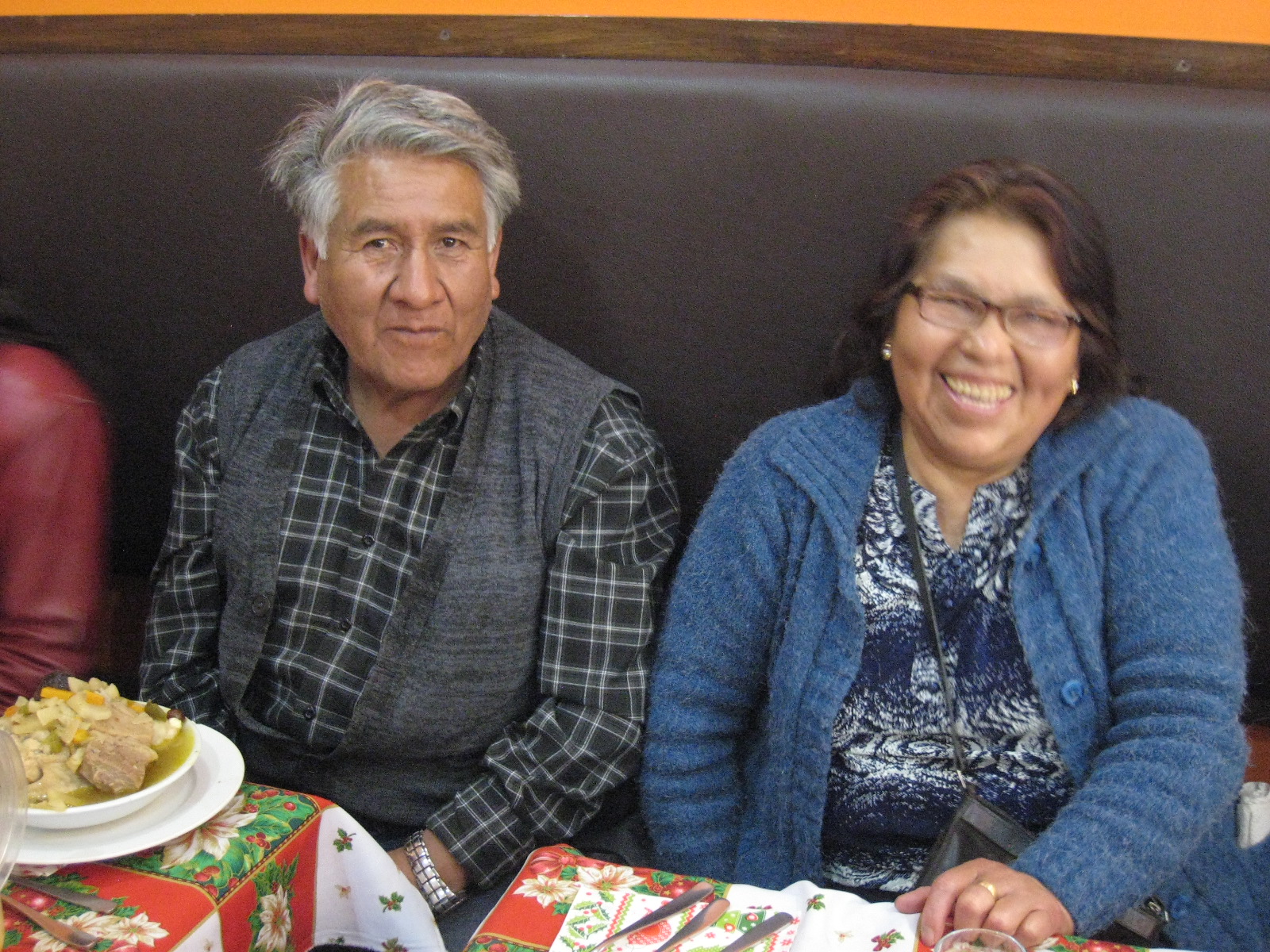
Humberto Gutierrez was in charge of the Spanish book, while I took on the writing of the book in English. Humberto's wife Petrona sits between us.

Felix Huarina, here with his wife Clementina, is in charge of the documentary film. The photo at the top of the article is the team with their family members at our Christmas party (2017).

Thursday, March 8, 2018

Mexican mariachi in a Bolivian celebration for two Oregonians


The past two weekends we’ve been heavily involved in gatherings of Friends leaders from around the Bolivian yearly meeting. Our history team has been sharing some of the findings of our investigations, especially of the past 28 years. (We talked about earlier periods in previous meetings.)
We’ve all been concerned about the lack of growth of the church. For the first 75 years, the Friends Church here added numerous congregations each decade. But since 1990, we’ve hovered right around 200 congregations. Some of the confusion comes in realizing that while the national missionary movement has added churches in new areas, at the same time an equal number of churches in other areas have closed.
So we’ve been talking about this, analyzing and reflecting, trying to discern causes and figure out how to move into the next 100 years (or at least the next 25 years) in a healthy way. The discussions have been hard, but necessary.
But even with this hard stuff, the Bolivian Friends Church is a celebrating church. And last Saturday afternoon, after a long, exhausting day of wrestling with the issues, we celebrated. Hal loves to visit with people after meetings and we’re usually the last to leave the premises. This time, as we were talking to Palermo and Hipólito, Reynaldo came and told us to hurry down to the fellowship hall for tea before we left. He then took us by the sleeve so we had to accompany him.
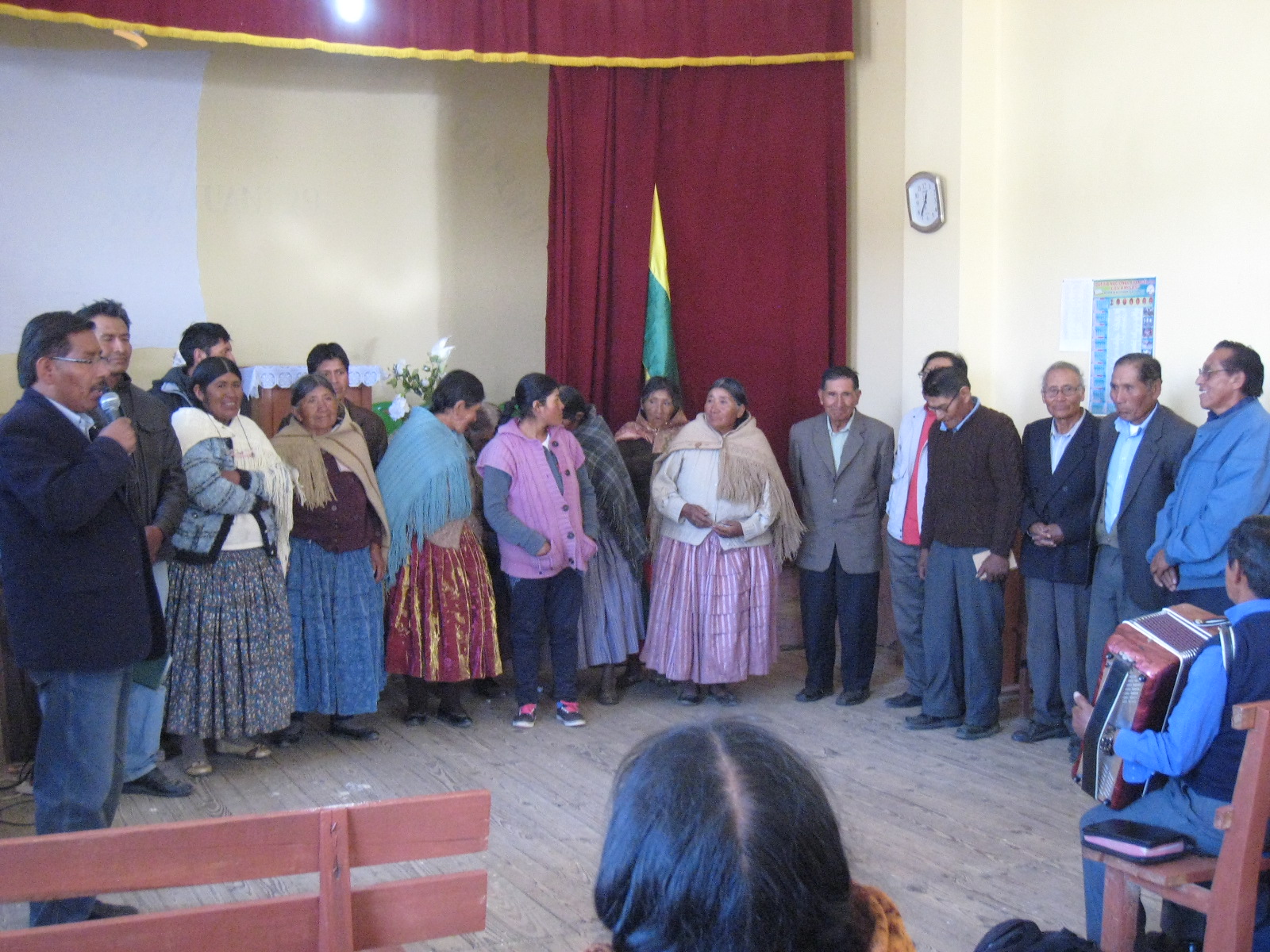
As we walked into the large room, a Mexican mariachi band began playing and people opened up a path for us. There in the front of the room was a three-layer cake with the words, “Happy 50th Anniversary, Hal and Nancy!” We were totally surprised. People clapped and yelled and made a lot of good un-Quakerly Latin American noise.
The celebration lasted a while, with everyone lining up to personally give us an abrazo and a blessing. The cake was yummy, the people even better. The band played the whole time. We learned that they were from the Cordillera Quarterly Meeting, a Bolivian Quaker mariachi band!
With all the hard stuff, the church is still the church. Lack of love is not one of the reasons for lack of growth!
(This was the third 50th anniversary celebration we’ve been treated to so far this year by Bolivian Quakers. And our actual anniversary isn’t until August.)

Words of congratulations by Friends president Hector Castro

Friends women bless us

How good to celebrate with friends!

Friday, February 2, 2018

Meet our team


We are now on the final stretch of our latest Bolivian adventure, trying to bring the Bolivian Friends history project to a good conclusion. None of this would be possible without our team. We’ve been together five years now, investigating, writing, filming. It will take most of 2018 (and possibly beyond) to come up with the final products of two books (in English for a North American and European audience and in Spanish for Latin America) and one documentary film.
Right now we’re in the tropical city of Santa Cruz, staying with the Tintaya family. David and Arminda are also part of our team. The family has consented to let me tell the story of their family, back four generations, as a summary chapter for the history book. So this last week I’ve been interviewing and writing. It’s inspiring to see the faithfulness of God through the generations.

We’ll head “home” to La Paz on Sunday afternoon and try to wind up this phase of the project. We’ll be spending that time with our team. Let me introduce you.

We celebrated together at Christmas.

Reynaldo Mamani, here with his wife Basilia and daughter Abigail, coordinates the Bolivian team. (Hal is over all coordinator.)

Humberto Gutierrez is chief investigator/writer for the book in Spanish. With him is his wife Petrona and myself (chief investigator/writer for the book in English).

Felix Huarina is our film producer, here with wife Clementina.

David Mamani, here with wife and son, is our technician. He set up the office and keeps the computers running.

Marcos Mamani, here with Elizabeth, is our treasurer and accountant.

Vicki Tazola is our archivist and has done a wonderful job putting the years of national church archives in order. Her daughter, Naomi, sometimes comes to the office to help her.

This is the La Paz team at our apartment, still celebrating.

We're with David and Arminda Tintaya in Santa Cruz, celebrating their 34th anniversary and our 50th.  Our team eats together a lot.

We thank God for these men and women. Together we just might get this task completed!

Friday, December 1, 2017

Flea powder evangelism

Last Sunday Hal and other members of our history team went out to Amacari, a village on the shores of Lake Titicaca and birth place of the first Friends church (INELA) about 100 years ago.  
(The photo is of believers from Amacari--the village is in the background--in the 1930s or 40s.)
The actual story of this congregation is mired in the mists of oral history. Different descendants of the original group each have their own version of how it all got started, as told to them by their grandparents. The events take place sometime between 1915 and 1924. As historians our strategy has been to collect all the stories, then try to identify the similar threads and arrive at a reasonable explanation of what might have happened.
Last week Hal and I celebrated Thanksgiving Day with some old friends (and Friends), Bernabé and Flavia Yujra. They actually live on land where the mission house once stood. Now three generations of the Yujra extended family live in various houses clustered around the large sunny patio.

Bernabé happens to be the grandson of one of the original Amacari believers, a man with the Old Testament Babylonian name of Baltazar Yujra. Bernabé told me a version of the Amacari story I hadn’t heard before. (I have three basic versions, with multiple variations.) He says his grandpa told him the story directly.
According to this version, a foreign missionary showed up in Amacara around 1917 and stood in the plaza playing his violin. But what attracted the people more was something he carried in his little medicine bag—flea powder! He told the people to sprinkle some in their beds to take care of their flea problem.
They did and it worked! The fleas all died (and, thankfully, none of the people did). People felt so grateful they were open to listen to the missionary’s message. Several converted and so the church was born.
This version of the story is so different from all the other versions—it has none of the similar threads that weave through the others—that, if I include it in the history book at all, it will probably be as a footnote. It makes me wonder if old Baltazar had a sense of humor and a healthy imagination, if he might have been pulling his grandson’s leg a bit. (He told a completely different version to another grandson whom we had previously interviewed.)
Well, I do have a healthy imagination, so I’ve tweaked the story further. I’d like to envision this fiddling missionary standing in the plaza, playing a Viennese waltz. Throughout the village, all the fleas wake up, enchanted by the music. They all crawl out of the beds, out the doors of the adobe huts, and make their way to the plaza. The missionary then turns and slowly walks out of the village, playing his violin, while a stream of fleas follows him. The villagers, thrilled at this miraculous liberation. all convert to Christianity and, thus, the church in Amacari is born.
(I won’t include this version in the book, not even in a footnote.)

Back to Amacari last Sunday, 2017. The brethren were glad to receive so many visitors, including members of the executive council of the denomination and representatives from the New Jerusalem Friends Church in La Paz—all determined to celebrate this milestone.
Actually, the Amacari Friends Church is still very much a rural community, and the people aren’t too wrapped up in dates and timelines. They hadn’t realized they were celebrating their 100th anniversary. (And the date, 1917, is somewhat arbitrary. People back them didn’t pay much attention to dates either.)
But, hey!, everybody loves a party. And celebrate they did!
Happy Anniversary, Amacari Friends Church!
One final observation: The fleas are back, but the church goes on.

Amacari believers at prayer in the 1940s

Celebrating their 100th anniversary

Wednesday, October 18, 2017

The beginning of the end


Last week we flew to La Paz, and yesterday we moved into the Hobbit Hole, a small apartment squished in between the New Jerusalem Friends Church and the large Friends school in back. The Hobbit Hole is directly under one of the school’s classrooms, and all morning long the kids have been reciting, singing, scrapping their chairs over the floor and, apparently, practicing for a violent overthrow of the government. I hope somebody is teaching Quaker peace-making. Some silence wouldn’t be bad either.
Last night we had a wonderful meeting with the people on the History Commission, the group we’re working with in this huge Bolivian Quaker history project. We’re encouraged by our team’s progress, initiative and motivation. And they’ve certainly given us a warm welcome.
I’m also encouraged by Jesus’ teaching on persistence in prayer: “Ask (and keep on asking) and it will be given to you; seek (and keep on seeking) and you will find; knock (and keep on knocking) and the door will be opened to you” (Luke 11:9). Here are the prayer requests that I invite you to ask and keep on asking concerning our concluding five months of work on the project here in La Paz:
--That God’s Spirit would fill and motivate us by love (Phil. 1:9-11): love for God that fuels our obedience and hard work; love for the church with all her blemishes and challenges; love for and among our team members. Love.
--That God’s Spirit would fill our team, that relationships stay healthy and open, that we all be able to focus on Christ and worship and work together.
--That we might discover the missing pieces in this complex story.
--For truth; that God would guard us from error and presumption.
--For insight into all the questions our investigation has brought up; for discernment to see where the Spirit was (and is) moving in all the events and problems and people that make up this story.
--For good writing.
--For the joy of the Lord to be our strength.
--For a successful conclusion to this project.
--For it to fulfill its purpose to bless and encourage the church, both in Bolivia and in the Northwest USA.

Amen. Lord, hear our prayer.

Tuesday, October 10, 2017

Leaving home, returning home

Once again we’re getting ready to change planets. Our son David will pick us up at 2:00 tomorrow morning and take us to the airport for our flight to Bolivia where we will spend the next five months.
Our friend Timoteo Choque will meet us at the La Paz airport Thursday morning at 6:00. It will be good to see him—and so many others—after an absence of a year and a half. We will spend the next months with the marvelous team of Bolivian Quakers, men and women, who have been working with us these past five years to research and write the 100-year history of the Bolivian Friends Church.
We plan to compare our findings and try to fill in the gaps. I look forward to scores of interviews, long discussions and time to re-write and edit. We hope five months will be long enough.
But this time, apprehension mingles with excitement. We were in our 20s when we first flew to Bolivia in 1972. Obviously we’re no longer in that phase of life. Our bodies now struggle more to adapt to the high altitude. While every bit as motivated by a sense of God’s call, we’re more vulnerable and certainly not as energetic as we used to be. We depend on the prayers of our loved ones—which is not a bad place to be.
And we have a different sense of home. While in many ways we’re going home to Bolivia, our lives have shifted since those early days of following God to a far-off land. Last year we took the plunge into a new adventure and moved into Friendsview Retirement Community. It was a major change and it’s taken us a while to adapt.
But we have adapted. This upcoming trip has helped me realize this. When people here express alarm that we will be gone five months, I’ve sensed some grief myself. It is a long time to be separated from my new family, and that sensation has helped me see that this is now home, too.
(Concern over separation from kids and grandkids is, of course, a given.)
So tomorrow we both leave home (with a certain sense of sadness) and we return home (with a great deal of anticipation).
More than all that we know that we carry home with us. Thesese of Lisieux once gazed upon the face of Jesus and prayed, “Your Face becomes my home, the radiance of my days, my realm and sunlit land.”

Oh, Lord, may it be so.

Monday, February 8, 2016

Facing the darkness…with love

This is a strange title for a progress report, but it’s what best reflects my sense of where we’re at. In regards to immediate time, we have three weeks left here in Bolivia to gather data, interview people and discuss our findings with our Bolivia team members. In terms of the overall project, we’re entering the fourth year of this five-year project to research and write the 100-year history of the Bolivian Friends Church (INELA).
A recent breakthrough (as in two nights ago) encourages me. It seems the official yearly meeting books of minutes from the year 1993 through the present time had gone missing. These are primary documents that include the time since 2002 after the mission had retired. I knew I wouldn’t be able to advance in my investigations without these resources. But Saturday night Tim did one more search in his office---and found them! He had a huge grin on his face as he brought the eight volumes down into our room and laid them on the table. (Timoteo Choque is the current president of the INELA.)
Although this means more detailed scanning work for me, I also grinned. Now I have something concrete to work with. I also groaned. These are eight volumes—200 pages each—of closely hand-written minutes. Some secretaries have clear hand writing; others don’t. Bolivian law requires that official minutes of legal organizations be hand-written and notorized.
(Pardon my spelling. The computer is telling me that “notorized” is misspelled, and suggesting I change it to “motorized.” I needed that suggestion. I need to laugh. It helps me work better. Right now I am imagining how I would handle all these hand written minutes if they were also motorized. I guess I would have to catch them before I could scan them. And would they even hold still for me? Probably not. They’ve been very elusive so far; why stop now?)
But more than the nitty gritty work load, I am feeling bowed down by the negative patterns we’re finding as we sort through all the data down through the years. We’re reminded that the church, while being the body of Christ in the spiritual realm, is also a human institution, affected by its surrounding culture, pounded by the events of history, and run by fallible human beings. This story is permeated by both light and shadows. The shadows tend to get to me. I find I have to fight against cynicism.
And fight I must. A year ago, our team adopted one of Paul’s prayers as our working motto, and we have it up on the wall in our office. Paul prays for the new believers in Philippi, “And this is my prayer: that your love may abound more and more in knowledge and depth of insight, so that you may be able to discern what is best….” (Philippians 1:9-10). We need faith to believe that this is God’s church, that the light (“all the light we cannot see”) is greater than the darkness. Above all we need love—love for God (we’re doing all this work for the glory of God—really, that’s more than a cliché to us), and love for the church herself. And not just the church as a shining spiritual concept, but the church as in the very real women and men, past and present, who attempt to follow Christ, who fail and fall, and who get up and keep going, sometimes groping, forward. According to Paul, it’s love, then, that will abound in knowledge, wisdom and discernment.

And that’s exactly what we need to move forward in this history project.

Thursday, January 21, 2016

The light we cannot see

We’ve been in La Paz three weeks now. Yearly Meeting has passed, and Friends are back to work. For me that means hours of going through INELA documents for the 1980s, deciding what might have relevance for that chapter of the history, scanning, transferring to my computer, filing. I’m preparing for the work of analysis and writing I’ll be doing back in the US for the rest of 2016. I hope to bring the project up to 2010 by the end of the year, and I’m beginning to wonder if my goal may be too ambitious. The amount of paper to paddle through is daunting. And that’s even before I get to the archives back home in Newberg.
One of my ways to rest and play is reading, and my iPad is loaded with good books for this trip. One of the best, so far (and probably for the rest of the year), is Anthony Doerr’s All the Light We Cannot See, a book of historical fiction that takes place in France during World War II. The protagonists are two children, a blind French girl and a poor German orphan boy, on opposite sides of the war, both struggling through tragic circumstances, yet with minds-alive, eager to learn. They both manage to find good, the light hidden in this awful time in history.
The title sticks with me and is helping me find my way through the history of Friends in Bolivia. Much of the INELA’s story takes place in a background of oppression and struggle, and some of the internal patterns that emerge are dark. The human side of the church has to be acknowledged. I’m continually asking myself, “Where is Jesus in all of this?” I’m seeking the footprints of the Spirit, the grace that, however hidden, was there at every turn of events.
It helps to identify the evidence of God’s Spirit, alive and well today. Grace sightings. Here are a few that have popped up in these few weeks we’ve been here:
--The faithful, dedicated work of members of our history team, especially Humberto, Felix and Victoria. All the investigative trips out to interview old Friends have borne fruit, but have required sacrifice and hard work. Victoria’s patient work in the yearly meeting archives is finally bringing order out of chaos. (Victoria, above)
--The camaraderie and fellowship our team enjoys. It brings to life the concept that “The joy of the Lord is our strength,” and that this joy is often found in relationships as God’s children work together on a certain task.
--Sharing a meal with Palermo and Olivia, learning how God is helping them overcome economic hardships and build a life for themselves as young professionals. 
--Sharing another meal with Tim and Elise, rejoicing in their new home and how it has opened up for them possibilities of ministry and hospitality. Tim is yearly meeting superintendent and represents a new generation of professional Aymara Quaker leadership. I sense in him the humility to relate to his past with gratitude, even as he moves forward.
--The joy of worshipping in the Aymara language, another vehicle of grace.
--The doves that coo above our door in the early morning. The sound of the hard rains that pound the roof at night.
--Fresh bread, fried country cheese, mangos and papayas any time we want them.
--Sun light illuminating the sides of the city that climbs the walls of this canyon called La Paz. The buildings shine. The distant Andes Mountains rise above them.

Lord, show me your grace, hidden in the ordinariness of life. Show us all the light we cannot yet see in the history of your people here in this place. Open our eyes.


Sharing a meal with Olivia and Palermo


Friday, November 20, 2015

Taking courage from our differences


In the Bolivian Friends history project, I am currently researching the 1970s. As usual my work involves wading through a lot of tedious detail and occasionally finding hidden treasure.
This decade especially fascinates me because Hal and I enter the story. We first arrived in Bolivia in January 1972. I find my head sticking up out of the letters and minutes and minutia I’m wading through. In fact, I wrote many of those council minutes. My memory is adding spice to the task.
One such minuted item, a piece of hidden treasure, involved a rather tense discussion in a mission council meeting. I remember it well. The mission team at that time was made up of Ron and Carolyn Stansell, Gil and Louise George, and Hal and me. Our friendship and trust gave us the freedom to disagree, and sometimes we did just that.
The particular issue that day was important. We were wrestling through ways to relate to a national church that was experiencing growing pains; we were seeking a path that was holistic and healthy. Ron expressed the view that our theological and biblical work was key, that we needed to focus on the formation of leaders who “rightly handled the word of truth.” Ron had been instrumental in beginning the extension Bible school program and an interdenominational seminary for pastoral training.
Gil countered that the key was not education but simply warm pastoral care of our leaders. He found great value in our task of driving teams of leaders to the conferences and gatherings around the country. Being in the cab of the pickup with different people for hours on end seemed a wonderful opportunity to listen, encourage and pray with people. Gil and Louise were the newest members of our staff and the only ones with actual pastoral experience.
Then Hal piped in with another perspective. The key to our relationship, he said, is understanding the culture of our people—their values, ways of making decisions, family ties, and worldview. Hal came to the task equipped as an anthropologist, and he was deep into his investigations of the Aymara culture.
At one point in the meeting (and this is a point that comes from memory, not recorded in the minutes), one of the women (and I can’t recall who) observed that bringing together these three perspectives—the biblical, pastoral and cultural—made for a very holistic approach. While that seems obvious in retrospect, it was an aha! moment for me. Hope replaced the tension I had been feeling. And that hope continues to warm me.
I can’t say, of course, that from then on the way forward was clear. We continued to struggle and work through all sorts of issues. But God was with us and with the church, giving light, slowly bringing about maturity. The insight I gained in that council meeting made a difference to me.
And it encourages me now as I wrestle with the different points of view on issues Friends in the northwest—and all over the country—are facing, within ourselves and in our surrounding contexts. It encourages me to slow down, listen carefully, value the differing perspectives, and know that as we stay together God will lead us. And take care of the church.